


Topics
About our Topics
The National Archives has selected a number of topics that correspond to the lifecycle of the documents.
- Information management and supervision. Archives are primarily created and preserved to support the tasks of an organization. In this phase, the National Archives supervises the management of this information.
- Valuation and Selection. Part of good management is that the archives must be valued and selected after 20 years.
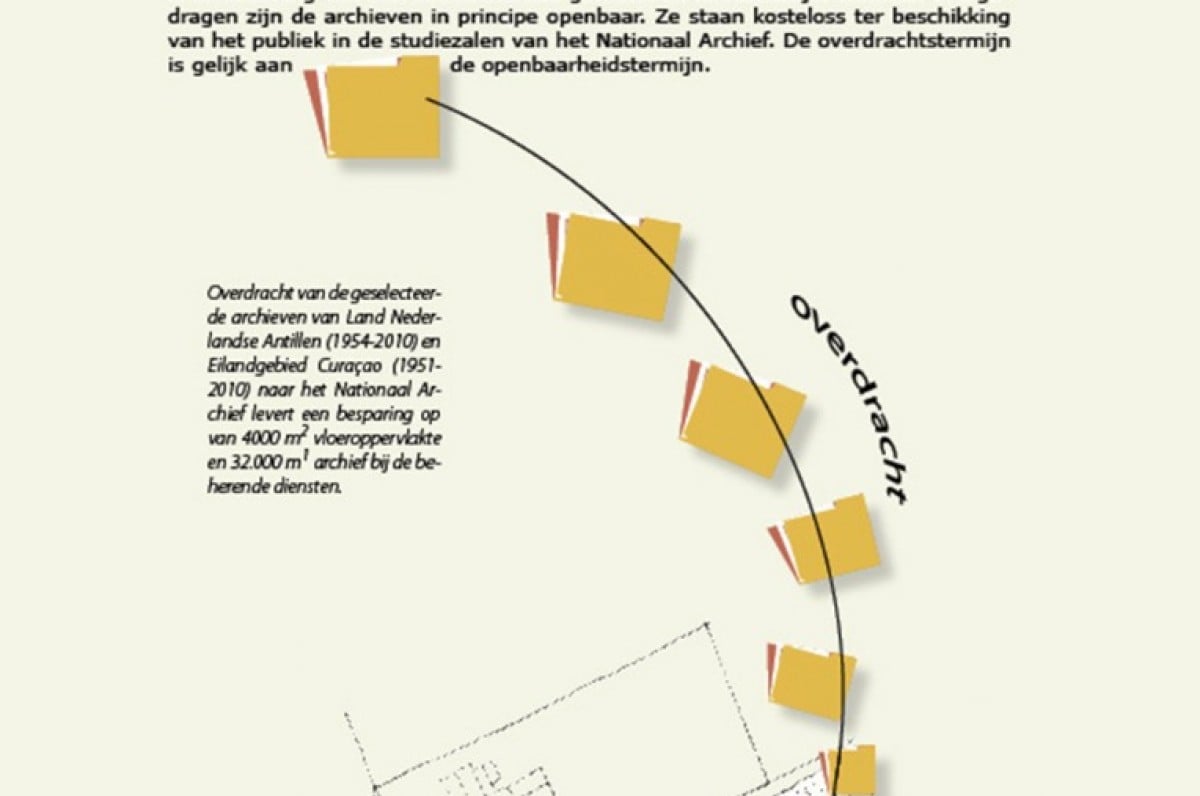
- Transfer and Public Access. After selection, the 20-year-old documents are transferred to the National Archives. This makes them publicly accessible.
In addition to this lifecycle, a number of extra topics have been included.
Archival legislation Introduction
The first National Archival Ordinance of the Netherlands Antilles (PB 1989, no. 64) entered into force in 1996. Since then, government services have been required to transfer their selected archives to the National Archives. The term for this was set at 40 years. The current National Archival Ordinance (PB 2008, no. 7) sets the term for transfer at 20 years. This National Archival Ordinance is now in force for the country of Curaçao. It is the country’s public access law. It is a framework law, which means that many articles are further elaborated in a separate law: the Archival Decree (PB 2008, no. 26).
The National Archival Ordinance PB 2008, no. 7 is inspired by the Archives Act of the Netherlands 1995, but is fundamentally different in structure and organization. The central focus is on the division into before and after transfer (the 20-year period during which government services must transfer their archives to the National Archives). This is also the most important turning point in the document’s lifecycle:
The custodian changes, the manager changes, and the public access status changes.
In outline:
| Before transfer (younger than 20 years) | After transfer (older than 20 years) | |
| Care | The responsible minister of the government service | Minister of BPD |
| Management | The manager of the government service The General State Archivist | The General State Archivist |
| Supervision | The General State Archivist |
Attachment(s)
- National Archives Ordinance (PB 2008, no. 7) (1.2 MB)
- Explanatory Memorandum PB 2008, no. 7(0.9 MB)
- Archives Decree (PB 2008, no. 26)(0.9 MB)
- Appendix to the Archives Decree (1.4 MB)
- Rules for digital management (1 MB)
Some frequently asked questions:
Scope (for whom or what is this law valid?)
Care, management, and supervision
Openbaarheid
Selection and destruction
Substitution
Foto’s

Reuse of Government Information
What is the reuse of government information?
The reuse of government information, or “open data,” means that data created or collected by the government is reused by citizens, businesses, or organizations for a purpose other than that for which it was originally intended. In principle, this information must be made available free of charge so that everyone can use it. This reuse can be either commercial or noncommercial. Examples include companies that use open data to develop apps, such as apps with public transportation or weather information. The primary goal is to promote innovation and economic growth.
Can the archives/materials of the National Archives be reused?
No, reuse as defined in the European Union’s Open Data Directive (EU) 2019/1024 or the Law on the Reuse of Public Sector Information is not possible because European open data legislation does not apply in Curaçao. This means that the rules and obligations regarding the reuse of public sector information, as they apply within the European Union and in the Netherlands, do not apply here. Local laws and regulations govern the use of archival material. The National Archives may also impose conditions on the use of archival data, for example, to protect the material, for reasons of confidentiality or privacy, or because copyright restrictions apply to the material.
Why is the reuse of archives specifically not permitted in Curaçao?
Archives do not qualify as mere government data but constitute documentary evidence of actions taken. “An archive is the collection of archival records arising from an organization’s work processes and managed, preserved, and made available in a coherent manner.” In the context of archival research, these documentary records must always be consulted within their original historical, legal, and administrative context. Reusing and/or publishing such official documents outside this context undermines their interrelationship and meaning, and violates the principle of provenance. Furthermore, this may compromise accurate and verifiable citation of sources.
The use of archival material in Curaçao is regulated by law under the 2007 Archival Ordinance. (link to lv) This ordinance provides the legal framework for the management, accessibility, and use of archives as part of the country’s cultural and administrative heritage. The use of archival material is permitted for consultation and research free of charge, but is subject to legal conditions. For example, restrictions may apply to protect privacy or—when disclosure would result in a disproportionate advantage or disadvantage to legal entities. These restrictions expire after 70 years.
In addition, the use and consultation of archival material is permitted only in a manner that does not compromise its integrity and/or content, and with proper attribution to the National Archives of Curaçao.
Universal Declaration on Archives
Universal Declaration on Archives in Papiamento on the ICA website
On November 10, 2011, the UNESCO General Assembly adopted the “Universal Declaration on Archives.” Since 2018, the Universal Declaration on Archives has also been available in Papiamentu on the website of the International Council on Archives (ICA). Translated by students of the Archival School in Curaçao.
Archives document decisions, actions, and memories. Archives are a unique and irreplaceable heritage, passed down from generation to generation. From the moment they are created, archives are managed in such a way that they retain their value and significance. They are authoritative sources of information that support responsible and transparent governance. They play an essential role in the development of society by safeguarding and contributing to individual and collective memory. Free access to archives enriches our knowledge of society, promotes democracy, protects civil rights, and enhances the quality of life.
When the Universal Declaration on Archives (UDA) was adopted by UNESCO, reference was made to important statements on knowledge and information, including UNESCO’s own constitution, which emphasizes the desire of member states to “preserve, increase, and disseminate knowledge.” Reference was also made to the Universal Declaration of Human Rights, which states that “everyone has the right to seek, receive, and impart information and ideas through any media, regardless of frontiers.” Together with the principles articulated in the Charter on the Preservation of Digital Heritage and the Memory of the World Program, the “Universal Declaration on Archives” aims to ensure the preservation and universal accessibility of the world’s documentary heritage. UNESCO encourages Member States to be guided by the principles set forth in the UDA when planning and implementing future archival strategies and programs at the national level.
Attachment(s)
- Universele Verklaring voor Archieven
- DEKLARASHON UNIVERSAL DI ARCHIVO (UvA vertaald naar Papiamentu)
Information Management and Supervision

What is archive inspection and wh
In short, archival inspection is the supervision of the management of government information and archives. This supervision is regulated by Article 3 of the 2007 National Archives Regulation (Official Gazette 2008 No. 7) and is therefore carried out by the Inspection Department of the National Archives.
For a clear understanding, it is necessary to further explain the term “archives.” Archives, or work-process-related information, constitute the memory of your organization. Government agencies produce information, both on paper and digitally, in the course of performing their duties and use this information for a variety of purposes, such as to support their work, as evidence, and to account for their actions to citizens and the administration. The quality of this “work-process-related” information has a major impact on government performance, for both the administration and citizens. It is a prerequisite for transparency, citizen participation, accountability, efficiency, and—in the longer term—cultural and historical heritage.
Oversight of information and records management is not a matter of choice. In addition to the provisions of the National Records Ordinance and the Records Decree, laws such as the National Ordinance on Public Access to Government Information and the Digital Management Decree impose obligations regarding information and records management. Beyond these legal aspects, an archival inspection is also intended to contribute to the development of your organization. Just like a financial management audit or an operational audit, an inspection provides you with clarity regarding the quality of information management within your organization, the bottlenecks and risks, and recommendations for potential solutions.
What forms does supervision take?
The National Archives employs various forms of supervision, each with its own target group and approach. Reports are submitted to the responsible administrator and, when the inspection deems it necessary, to the minister in charge.
Quality Inspection
The quality inspection serves to provide an organization’s management with insight into the functioning of information and records management, identify strengths and weaknesses, highlight risks, and offer recommendations for quality improvement. In doing so, all aspects of information and records management are analyzed in conjunction with one another, and a three-part quality criterion applies: added value for work processes, lawful management in accordance with laws and regulations, and finally, effective management.
Thematic inspection
The National Archives may also conduct thematic inspections. This means that inspections are conducted around a specific theme. This may, for example, concern the condition of archive spaces or the quality of personnel.
Ad hoc inspection
Certain situations, such as the commissioning of an archive room, the introduction of a new information system, or a disaster, such as a flood, may warrant an ad hoc inspection.
How does it work at the National Archives?
The Archives Inspector sees its role primarily in ensuring the quality of information and records management. It uses the records management laws and regulations, as set forth in the 2007 National Records Ordinance (P.B. 2008 no. 7), as its assessment framework. Expert, with conviction, but also committed and realistic. With a keen eye for the objectives of government institutions as a whole.
National Archives
Scharlooweg 77-79
Tel. 461-4866 – Fax 4616794
Foto’s

Valuation and Selection

What is valuation and selection?
“A government body shall bring and keep the archival records in its possession in good, orderly, and accessible condition and shall also ensure the selection and destruction of the archival records eligible for this, in accordance with rules to be established by national decree containing general measures.”
This is the text of Article 3 of the National Archives Ordinance.
For proper information management, it is necessary for the archive to be “cleaned up,” that is to say, that documents suitable for destruction are selected out and the most valuable documents are preserved. This benefits accessibility, protects privacy data, and ultimately allows the important documents to be transferred and made public. Good management also takes the lifecycle of the documents into account.
‘Cleaning up’ an archive is done by means of selection. Within the government, archive selection is mandatory. To determine which part of the archive must be preserved and which part must be destroyed, a “valuation” is required.
How is it determined what must be destroyed and what must be transferred?
What is destroyed or not must be accounted for in lists. The first concept is called a “selection list”. Creating a selection list is extremely important for an organization.
On Curaçao, two methods are possible. The Archives Decree addresses these methods in Articles 2 through 9.
Firstly, a sample list of retention periods has been established. An organization can use this list as a guideline and draw up a list of retention periods for its own organization that is consistent with it. It is a time-consuming method because almost every single item must be selected individually. (You can download the sample selection list on this site, under Archives Legislation Introduction – Annex to the Archives Decree).
With the second method, selection is based on the tasks or actions of the organization. The archive is generated by an organization as a result of the tasks it performs. These tasks can be assessed; when creating a list for permanent preservation and when assigning retention periods, the Archives Decree requires taking into account:
- The task of the government body;
- The relationship of this government body to other government bodies;
- The value of the archival records as a component of cultural heritage;
- The importance of the data contained in the archival records for:
– Government bodies
– Those seeking legal redress or evidence
– Historical research.
A so-called “list of actions” is drawn up via an analysis of the tasks (an institutional study). It is mapped out which archival documents yield the “actions.” A retention period is linked to this. The selection list drawn up in this way is a first draft.
Who determines what is destroyed and transferred?
The first draft is drawn up by (or on behalf of) the organization itself. The organization that created the archive is pre-eminently expert regarding the business interests of the documents. They know better than anyone else which tasks they are required to perform and how they must account for them. Initially, therefore, they also determine which documents from their organization will be transferred and thus must be made public. The first list must be approved by the management of the archive-creating organization. In addition, the list must be approved by the State Archivist, who is an expert on the historical significance of the documents.
If they approve the list, the selection list acquires a definitive status and transfer or destruction can proceed.
election takes place on behalf of the custodian; the responsible minister must be informed that the correct procedures have been followed. Selection therefore determines the fate of archival records: they are either destroyed or preserved.
Transfer
Documents designated for permanent preservation must be transferred to the public archive repository, which is the National Archives depot, after twenty years. A file to be preserved is transferred when the last document is twenty years old. In addition, early transfer or suspension of transfer is also possible.
Transfer to the National Archives must take place in an inventoryed manner. See also under “Transfer and Public Access”.
Destruction
Burgers moeten erop kunnen vertrouwen dat te vernietigen informatie die in de geaccordeerde selectielijst staat opgenomen ook daadwerkelijk wordt vernietigd en daarmee echt verdwijnt. Als een bewaartermijn is verstreken, moeten de bescheiden zo snel mogelijk worden vernietigd. Dat kan alleen aan de hand van de selectielijst. An official report must be drawn up regarding the actual destruction. Overheidsbescheiden die niet in een selectielijst zijn opgenomen, mogen tot die tijd niet worden vernietigd. De overheid mag dus niet zomaar informatie laten verdwijnen. Er moet altijd een specificatie zijn van wat vernietigd is. Het Proces Verbaal van vernietiging moet worden bewaard door de archiefvormende organisatie zelf.
Bij vragen kunt u gerust contact opnemen met de afd. Inspectie en Acquisitie van het Nationaal Archief (T. 461 4866).
Foto’s


Restoration
Een prachtige documentaire over de restauratie van het Juliana Brenneker archief.
Transfer and Publicity
Articles 17 and 18 of the National Archives Ordinance regulate the transfer of archival documents to the National Archives. Of importance in this regard is that:
1. The archives of all government institutions must be transferred after 20 years;
2. Only documents that cannot be destroyed can be transferred.
The latter means that the documents must first be selected. The documents that can be destroyed must be removed.
Transfer takes place at the behest of the custodian. This means that the responsible minister must be notified. It is possible to transfer documents younger than 20 years to the National Archives in advance. To do so, consultation with the State Archivist must take place first. It may also occur that documents older than 20 years are still regularly consulted, and a request for a postponement of transfer may be made. Suspension can only take place at the behest of the responsible minister and for a maximum period of 10 years.
As soon as the archives have been transferred, they are under the management of the State Archivist. The transfer is a so-called management transfer. The manager of the archives and the manager of the National Archives (State Archivist) sign the deed of transfer. The deed also includes provisions regarding which documents must not yet be made public (for the time being). In principle, the documents are public as soon as they have been transferred. The period of public access in our country is therefore 20 years.
Any restrictions on public access expire after 70 years.
Eventuele openbaarheidsbeperkingen komen na 70 jaar te vervallen.
Foto’s

Projects
Selection Project
A major selection project took place in January 2017. Over a period of two years, a team of five experienced selectors selected the administrative archives covering the years 1939–2010, which were stored in “Big One” on Gosieweg / Bonamweg. The intention was to reduce the volume of administrative archives—2 linear kilometers—by about 10–15%, after which the historically valuable documents would be inventoried and transferred to the National Archives. These documents will then become available to you, as a visitor. This represents a tremendous advancement for our services. From 1969 to the present, the National Archives could only make government archives up to 1939 available to you for inspection. In a few years, you will be able to consult the government archives up to 2010. A part of the colonial era, the war period, and the entire period of the autonomous country of the Netherlands Antilles will become available for historical research. This selection project also serves as an internship placement for students of the Archives School.
Archives School
The Archive School was intended to train a new cadre of qualified administrators in Curaçao. This was necessary not only for the National Archives but also for all ministries. The National Archives had a qualified cadre for this purpose who had previously completed the legally required training at the Archive School in The Hague. Of the 6 administrators sent to the Netherlands in this manner, 5 are now retired. The ministries have a backlog of more than 40 linear kilometers of archives to be selected and transferred. The lack of experienced selectors within the ministries is a major loss. The new training program has also trained selection specialists, as well as ‘information officers’ who can function at a policy level within the apparatus.
MIGAN / AtoM
MIGAN stands for “Memory of the Islands: Gateway to Archival Networking”. It is a collaborative project conducted through CARBICA, the “Caribbean Branch of the International Council on Archives”. A number of CARBICA members have agreed to exchange a selection of their collections and make them accessible via a web portal. This concerns collections of shared Caribbean interest. This involves slave registers, migration records, and, for example, genealogical data. The exchange of this data between the various Caribbean members makes comparative historical research possible. The collaboration has been established between Curaçao, Martinique, Suriname, Trinidad and Tobago, and Guadeloupe. The cooperation also entails the establishment of a training program for these members to standardize the data. In order to exchange the data, it must be converted into an international standard for archival descriptions called AtoM (“Access to Memory”). The intention of the National Archives is not only to convert the selected collections into this standard, but to describe all inventories in this way. In the future, it will then be possible to browse the inventories of the National Archives via the Internet.
Om de gegevens te kunnen uitwisselen moeten ze worden omgezet in een internationale standaard voor archiefbeschrijvingen, genaamd AtoM (“Acces to Memory”). De bedoeling van het Nationaal Archief is om niet alleen de geselecteerde collecties om te zetten in deze standaard, maar alle inventarissen op die manier te beschrijven. Het wordt dan in de toekomst mogelijk om via Internet te bladeren in de inventarissen van het Nationaal Archief.
Beeldbank
Since 2016, the National Archives has had a digital image bank. The intention is for all photos to become digitally available in this image database. To achieve this, they need to be described. We could really use your help as a volunteer, as old buildings, faces, and events can be recognized in many photos. If you would like to help us, please feel free to call 461 48 66 to sign up for this project. You will receive an explanation and brief training, after which you can describe the photos from home, or you can help us scan photos.
Inventories online
In 2017, the inventories were placed online as planned. You can browse and search our inventories for any location down to the item level.
Stamboom gegevens online
We placed the Civil Registry indices online via the website WieWasWie.nl. Since 2017, the updated indices have been made available on our own website.
Archives School
The National Archives, in collaboration with the Intercontinental University of the Caribbean (ICUC), has organized a program in Information and Archives Management (Archives School). To date, 22 civil servants from 8 different ministries have completed the program.
This program has been recognized as a higher professional education (HBO) program by the Minister of Education, Science, Culture, and Sports. The program focused on managing information throughout its entire lifecycle. Archives—the records of tasks performed—are more than just “information” or “documentation”; they are unique and irreplaceable materials that serve to support operations, provide evidence for accountability, and ultimately act as a means for active democratic oversight of government functions. A modern term for this type of unique information is “process-related information.” Often, an organization manages that information only for the period during which it is actually needed. Once the process is over, it is no longer clear what to do with it. Should it be retained? For how long? Should it be destroyed? According to which procedure? If it must be retained, under what conditions, and when does it become public? Can paper be replaced by a digital archive? How should it be secured in a digital network?
It is clear that these questions exist, but the answers are unknown: the government of Curaçao manages more than 40 kilometers of archives, about 90% of which are eligible for destruction. More than 2 million guilders are spent on storing archives that could—and should—have been destroyed long ago. According to the new National Archives Regulation, the transition from paper to digital is possible, but the terms and conditions are still largely unknown. The students of the Archives School will form a new cadre who will thoroughly master and understand the ins and outs of these issues. Sustainable accessibility and the transition to a Digital Information Management system are key topics for these new professionals.
The program lasted three years and has now been completed.
Publications
The National Archives publishes its own publication called “Lantèrnu”. In the Lantèrnus, various historical subjects are explored in depth. Inventories are also published as Lantèrnu.
See the attached list of Lantèrnus.
Sales List Service Department
| lantèrnu nr 1 jrg 1 | Feb-1983 | Emancipation | Fl. 4.75 |
| lantèrnu no. 2 vol. 1 | Nov-1983 | Boards of Directors of the Netherlands Antilles | Fl 7.50 |
| lantèrnu no. 3+4 vol.2 | Dec-1984 | Inventory of the archives of the government of the island territory of Sint Eustatius | Fl. 9.50 |
| lantèrnu no. 5+6 vol.3 | Dec-1985 | Socio-economic history of the Netherlands Antilles | Fl. 7.50 |
| lantern no. 7 | Aug-1987 | Slavery in a Nutshell | Fl. 8.50 |
| lantern no. 8 | Apr-1988 | The Centenial of the bridge Queen Emma of the Netherlands Antilles | Fl. 54,- |
| lantern no. 9 | Sep-1989 | Key moments in the constitutional development of the Netherlands Antilles | Fl. 13,- |
| lantern no. 10 | 1990 | Private Archives: SW Rigaud archive. Inventory of the de Lannoy family papers. | Fl. 10,- |
| lantern no. 11 | Dec-1991 | Otrabanda (Brion and Molenplein) | Fl. 20,- |
| lantern no. 12 | Sep-1992 | Shell gains ground | Fl. 20,- |
| lantern no. 14 | March 1994 | The Handelskade. The quay of the waterside. | Fl. 25,- |
| lantern no. 15 | May 1995 | May 30, 1969. Newspaper clippings and photos of the events surrounding May 30, 1969 from local daily and weekly papers. | Fl. 45,- |
| lantern no. 16 | Apr-1988 | The establishment of the first five years of the West Indies Division of KLM 1934-1939 | Fl. 20,- |
| lantern no. 17 | Aug-1999 | 30 years of the Central Historical Archive of the Netherlands Antilles | Fl. 30,- |
| lantern no. 18 | February 1998 | Inv Cabinet of the Governor of the Netherlands Antilles (1949) 1951-1990; the archive | Fl. 35,- |
| lantern no. 19 | 1999 | Ana 1999. ana di rekonosementu/commemorative year 1999 | Fl. 20,- |
| lantern no. 20 | 2000 | lectures 2000 | Fl. 20,- |
| lantern no. 21 | Korsou su Muhenan Pionero | Fl. 50,- | |
| lantern no. 22 | 2003 | Commemorative book 140 years of Emancipation | Fl. 15,- |
| lantern no. 23 | 2011 | Inv Cabinet of the Governor of the Netherlands Antilles. Annex (1951) 1991-2010 | |
| lantern no. 24 | 2015 | Curaçao, a thorn in the side of Venezuela. | Fl. 10,- |
| lantern no. 25 | 2020 | On the Terrace. With stories from the history of Curaçao. (anniversary book on the occasion of 50 years of the National Archives / in collaboration with the Friends of the Archives Foundation) | Fl 50,- (sold out) |
| lantern no. 26 | 2022 | Cabo de Hornos. | Fl 10,- |